

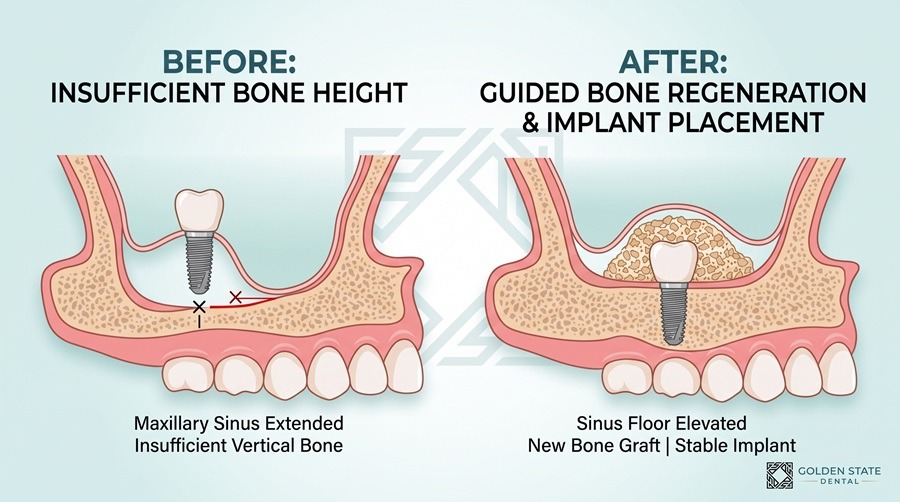
When replacing missing upper molars or premolars, standard dental implants require sufficient vertical jawbone height to anchor firmly. For many adult patients, however, natural bone loss or an enlarged maxillary sinus leaves the posterior upper jaw too thin to support a titanium fixture safely.
This is where specialized upper jaw bone grafting becomes essential. A sinus lift, clinically termed sinus augmentation, creates a stable, durable foundation so you can restore your bite permanently. At Golden State Dental Co., our board-eligible and board-certified surgical team routinely performs advanced sinus lift surgery to help patients throughout Sacramento, Folsom, and Roseville regain full oral function.
What Is a Sinus Lift Surgery?
A sinus lift is a specialized oral surgery that elevates the sinus membrane and places bone graft material into the floor of the maxillary sinus to increase vertical bone height for dental implants.
The maxillary sinuses are air-filled spaces situated right above your upper back teeth. When an upper molar is removed or lost to periodontal disease, two anatomical changes happen simultaneously:
- The alveolar ridge (jawbone) begins to resorb and thin out without the natural stimulation of tooth roots.
- The maxillary sinus expands downward into the empty space, a process known as sinus pneumatization.
If the bone between the oral cavity and the sinus cavity measures less than 4 to 6 millimeters, placing an implant without bone grafting risks perforating the delicate Schneiderian membrane or leaving the implant unstable. A sinus augmentation for dental implants safely restores that missing height.
Surgical Techniques: Lateral Window vs. Crestal Approach
Depending on the amount of native bone you currently have, your periodontist or oral surgeon will select one of two primary methods:
1. The Lateral Window Technique (Direct Approach)
- When It Is Used: When existing vertical bone height is severely depleted (typically less than 4 mm).
- The Process: A small window is created in the outer wall of the upper jawbone. The surgeon carefully lifts the sinus membrane upward and packs a generous amount of specialized bone graft material beneath it.
- Timeline: The graft typically requires 4 to 6 months to mature and integrate before the implant post can be surgically placed.
2. The Crestal / Osteotome Technique (Indirect Approach)
- When It Is Used: When you already have moderate bone height (around 5 to 7 mm) and only need an additional 2 to 3 mm of lift.
- The Process: The membrane is gently elevated directly through the small hole prepared for the implant fixture, using specialized micro-instruments.
- Simultaneous Placement: In most crestal cases, the sinus lift with bone graft and the dental implant are completed in the exact same visit.
What Types of Bone Graft Materials Are Used?
Modern regenerative dentistry offers biocompatible graft matrices tailored to your anatomy and preferences:
- Autografts: Natural bone harvested from your own chin or palate, offering high osteogenic potential.
- Allografts: Safely processed, sterile human donor bone from certified tissue banks (the most common clinical standard).
- Xenografts: Highly biocompatible bovine mineral matrices that act as structural scaffolds, holding space while your body generates natural bone.
- Synthetic / Alloplastic Grafts: Bioactive mineral ceramics that support gradual natural remodeling.
At Golden State Dental Co., we often combine these materials with platelet-rich fibrin (PRF) derived from a small sample of your own blood to accelerate soft-tissue healing and cellular regeneration.
Step-by-Step: The Sinus Lift Procedure
Understanding the clinical workflow helps alleviate procedure-related anxiety:
- High-Resolution 3D CBCT Scans: Low-radiation 3D cone-beam computed tomography maps the exact contours of your sinus floor, bone density, and septa before surgery.
- Comfort-First Sedation: Local anesthesia numbs the treatment area entirely. For anxious patients, oral sedation or IV sedation ensures complete relaxation.
- Gentle Membrane Elevation: Specialized microsurgical instruments elevate the sinus membrane intact, without tearing.
- Graft Placement & Membrane Protection: Bone graft particles fill the void, and a protective collagen barrier shields the graft.
- Precision Suturing: The gum tissue is repositioned and secured with dissolvable sutures to protect the surgical site.
Recovery Timeline and Critical Post-Operative Rules
Recovery following sinus lift surgery is generally mild and manageable with over-the-counter or mild prescription anti-inflammatories:
- Days 1–3: Mild swelling, light cheek bruising, and minor sinus congestion are expected. Apply ice packs to the cheek in 20-minute cycles and rest with your head elevated.
- Days 4–7: Soft-tissue tenderness subsides significantly. Continue eating soft foods (smoothies, eggs, pasta) and avoid hot, spicy, or crunchy items.
- Months 4–6: The bone graft undergoes cellular remodeling, consolidating into living, dense bone ready for final dental implant restoration.
Vital Sinus Precautions:
Because the sinus cavity is healing, do not blow your nose, sneeze with your mouth closed, drink through straws, smoke, or fly on airplanes for at least 14 days post-surgery. Sudden pressure changes can dislodge the graft or compromise the healing membrane.
Restore Your Upper Smile with Precision Care
Missing upper molars do not have to limit your choices for restorative care. With advanced upper jaw bone grafting and 3D-guided surgical planning, dental implants remain the gold standard for long-term health, appearance, and chewing function.
Contact Golden State Dental Co. today to schedule your comprehensive 3D implant consultation at our modern practices in Sacramento, Folsom, or Roseville.
