


A luxated tooth (or dislocated tooth) is a serious dental emergency that occurs when sudden physical trauma forces a tooth out of its normal anatomical position. Whether triggered by an athletic collision, a cycling fall, or an unexpected slip, dealing with dislodged teeth requires immediate clinical intervention. Unlike complete tooth avulsion where a tooth is knocked entirely out, a luxation tooth remains inside the socket but may feel loose, pushed sideways, or driven directly into the bone.
At Golden State Dental Co., our specialized team delivers prompt emergency evaluations and advanced tooth luxation treatment across Sacramento, Folsom, and Roseville to stabilize the dentition and safeguard periodontal health.
What is Tooth Luxation? Understanding Dental Trauma
Think of dental luxation as a severe sprain or partial dislocation of the tooth structure. It happens when the periodontal ligaments and alveolar bone supporting the tooth sustain trauma. While the tooth remains within the alveolar bone, its alignment is altered: it may sit at an unnatural angle, appear noticeably elongated, or feel unnervingly unstable to the touch.
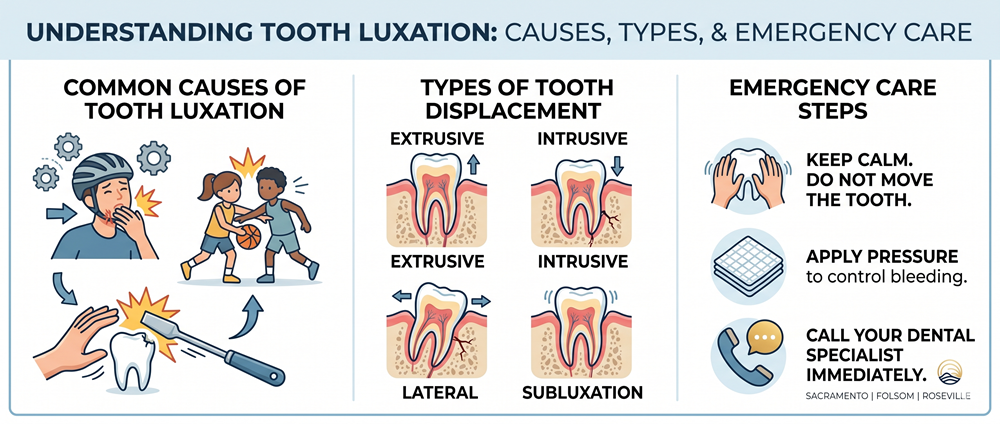
Common Causes of Dislocated Teeth
In clinical practice, dental luxation commonly stems from:
-
Sports Impacts: Contact sports like soccer, basketball, and mountain biking.
-
Accidental Slips and Falls: Direct trauma to the facial bones from tripping or sports collisions.
-
Mechanical Accidents: Workplace mishaps or motor vehicle collisions.
Understanding Types of Dental Luxation: Subluxation vs. Dislocation
Recognizing the specific pattern of injury determines the correct clinical protocol for stabilizing the tooth:
1. Concussion and Tooth Subluxation (Minor Trauma)
-
Concussion: The tooth absorbs a blunt force. It is neither loose nor displaced from its socket, but the periodontal ligament is bruised, making the tooth sensitive to biting pressure.
-
Tooth Subluxation: In a subluxation tooth injury, supporting periodontal fibers are damaged. The tooth is noticeably loose and may exhibit minor bleeding at the gumline, but it has not shifted from its original position. Prompt tooth subluxation treatment is essential to monitor nerve vitality and prevent long-term complications.
2. Extrusive, Lateral, and Intrusive Luxation (Severe Dislocation)
-
Extrusive Luxation: The tooth appears elongated because traumatic force has pulled it partially out of the socket.
-
Lateral Luxation Tooth: A lateral luxation tooth has been forced horizontally (forward, backward, or sideways). This dislocation frequently fractures the surrounding alveolar bone plate.
-
Intrusive Luxation: The most severe category of tooth dislocation, where the crown is forced axially into the alveolar bone, sometimes giving the illusion that the tooth is completely gone.
Symptoms of a Luxated or Dislocated Tooth
Following facial or oral trauma, clear diagnostic signs help confirm a luxation injury:
-
Visual Misalignment: The tooth looks crooked, tilted, unusually elongated, or partially submerged compared to adjacent teeth.
-
Tooth Mobility: Noticeable looseness or shifting when touched lightly by the tongue.
-
Altered Occlusion (Off-Bite): Teeth no longer fit together naturally when closing the mouth.
-
Thermal Sensitivity & Pain: A sharp ache triggered by cold air, fluids, or light biting pressure.
-
Marginal Bleeding: Active bleeding around the gingival margin of the affected tooth.
Emergency Action Checklist by Tooth Luxation Type
Use this quick-reference guide to identify your injury type, take immediate first-aid steps, and understand required clinical emergency treatments:
| Injury Type | Visual & Clinical Signs | Immediate Patient Action (First Aid) | Emergency Dental Care Protocol |
| Concussion | Tooth is neither loose nor displaced; tender to biting pressure. | Avoid chewing on the injured side; eat a soft diet for 1–2 weeks. | Pulp vitality monitoring; no active splinting required. |
| Subluxation | Tooth is noticeably mobile; minor gumline bleeding; no position change. | Do not manipulate with tongue or fingers; call an emergency dentist. | Occlusal adjustment; flexible splinting for up to 2 weeks if highly mobile. |
| Extrusive Luxation | Tooth appears elongated; partially pulled out of the bone socket. | Do not force the tooth back; bite gently on clean, damp gauze. | Repositioning under local anesthesia; flexible splinting for 2–3 weeks. |
| Lateral Luxation | Tooth is displaced horizontally (tilted forward, backward, or sideways). | Apply a cold compress to cheek; avoid touching the crown; seek prompt care. | Surgical disengagement from alveolar fracture; splinting for 4 weeks. |
| Intrusive Luxation | Tooth is driven axially into the alveolar bone; looks sunken or missing. | Do not attempt to pull the tooth down; rinse mouth gently; seek immediate care. | Spontaneous re-eruption monitoring, or surgical/orthodontic repositioning + root canal. |
First Aid Steps for a Dislodged or Luxated Tooth
Taking the right initial actions within the first few hours directly determines whether a dislocated tooth can be saved:
-
Do Not Touch or Wiggle the Tooth: Avoid manipulating the tooth with fingers or the tongue. Leaving torn periodontal ligaments undisturbed is critical for tissue reattachment.
-
Apply a Cold Compress: Place a clean ice pack or cold cloth over the cheek to manage facial swelling and alleviate localized throbbing.
-
Control Minor Bleeding: Bite gently on clean, damp gauze to stop bleeding without applying lateral pressure to the loosened tooth.
-
Seek Emergency Dental Care Immediately: Dental trauma is time-critical. Arriving at a dental office within a few hours dramatically increases the success rate of tooth stabilization.
Professional Tooth Luxation Treatment Options
Treating a luxated tooth focuses on realigning the structure, restoring bone support, and preserving the internal dental pulp:
1. Stabilization and Flexible Splinting
For most loose or displaced teeth, clinical stabilization is the first line of defense. A flexible wire or composite splint bonds the injured tooth to healthy neighboring teeth. Similar to a cast on a fractured bone, splinting holds the tooth rigid for 2 to 4 weeks while the surrounding periodontal ligaments knit back together. In cases involving severe soft-tissue trauma or bone fractures, comprehensive periodontal therapy is integrated to preserve surrounding tissue.
2. Endodontic Monitoring & Root Canal Care
High-impact trauma can sever or shock the blood supply to the tooth’s internal nerve (pulp). Continued vitality testing assesses whether the nerve recovers. If pulpal necrosis occurs, root canal treatment removes non-vital tissue, preventing deep-seated bacterial infections or future tooth discoloration.
Partnering with an Emergency Dental Specialist
Facing a dental trauma is a stressful, time-sensitive situation. Postponing professional care for a dislocated tooth or ignoring a loose subluxation tooth can lead to irreversible bone loss and eventual tooth extraction.
At Golden State Dental Co., our clinical team combines modern diagnostic imaging with gentle emergency treatments across Sacramento, Folsom, and Roseville. Contact our office immediately to stabilize your smile and protect your natural dentition.
Frequently Asked Questions
Is a luxated tooth considered a dental emergency?
Yes. A luxated or dislocated tooth requires immediate evaluation within a few hours. Prompt repositioning and splinting prevent irreversible ligament damage, alveolar bone infection, and premature tooth loss.
What is the treatment for tooth subluxation vs. severe luxation?
Tooth subluxation treatment typically requires gentle monitoring, a soft-food diet, and bite adjustment, as the ligaments often heal without rigid intervention. Conversely, severe lateral, extrusive, or intrusive luxation demands urgent manual repositioning under local anesthesia followed by flexible splinting for 2 to 4 weeks.
Why does an injured tooth change color over time?
If a tooth turns grey, pink, or dark yellow weeks after trauma, the internal blood supply was likely severed during the initial impact. A darkening tooth indicates pulpal necrosis and requires endodontic evaluation to prevent internal resorption or abscess formation.
